← All articles

What is a structured RFQ? How AI matching and verification work

A plain-English guide to RFQs — and how Soarix turns a structured one into an AI-matched, verified supplier shortlist for Indian B2B buyers.

By Soarix Editorial2 November 2026
What Is an RFQStructured RFQAI Supplier MatchingSupplier Verification
What is a structured RFQ? How AI matching and verification work
image

If you've ever typed "what is an RFQ" into Google at 11pm before a vendor deadline, this guide is for you. We'll start from the basics — what an RFQ actually is, and how it's different from an RFP or RFI — then go deep on what a structured RFQ means, how Soarix's AI matching turns one into a shortlist of verified suppliers, and what "verified" actually checks for.

What is an RFQ, exactly?

A Request for Quotation (RFQ) is a formal procurement document a buyer sends to potential suppliers, asking for a price quote against a clearly defined requirement. It's one of three standard procurement documents:

DocumentUsed whenMain decision factor
RFI (Request for Information)You're exploring the market and requirements aren't finalisedCapability & fit
RFP (Request for Proposal)You need suppliers to propose an approach, not just a priceApproach & value
RFQ (Request for Quotation)Your requirements are already fully definedPrice & delivery

An RFQ assumes you already know what you need — the specifications are fixed. What's being decided is who can deliver it, at what price, and by when. That makes RFQs the right tool for repeat purchases, defined components, and standard categories — which describes most B2B procurement in India: packaging, raw materials, components, and MRO supplies bought again and again from the same handful of categories.

What makes an RFQ "structured"?

In practice, most Indian businesses skip the formal document entirely. Sourcing starts with what we called, in our last post, the WhatsApp RFQ: a two-line message sent to three familiar vendors. It works, technically — suppliers do respond, purchases do get made. But it's missing the one property that makes an RFQ genuinely useful: structure. 

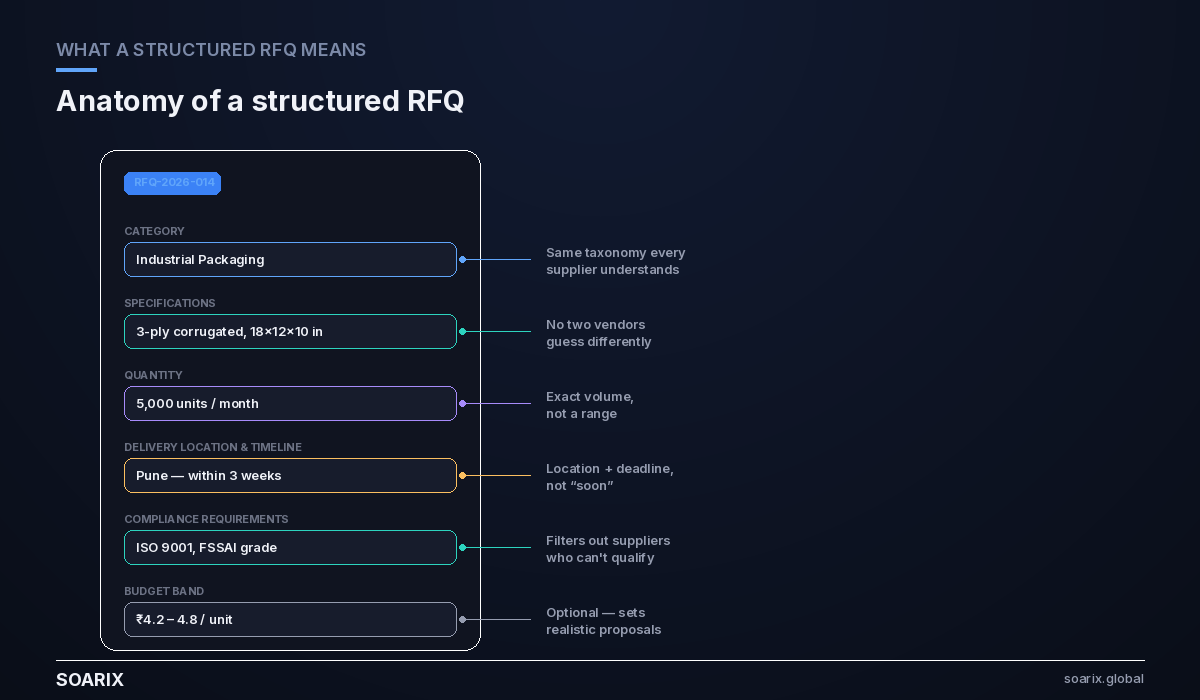
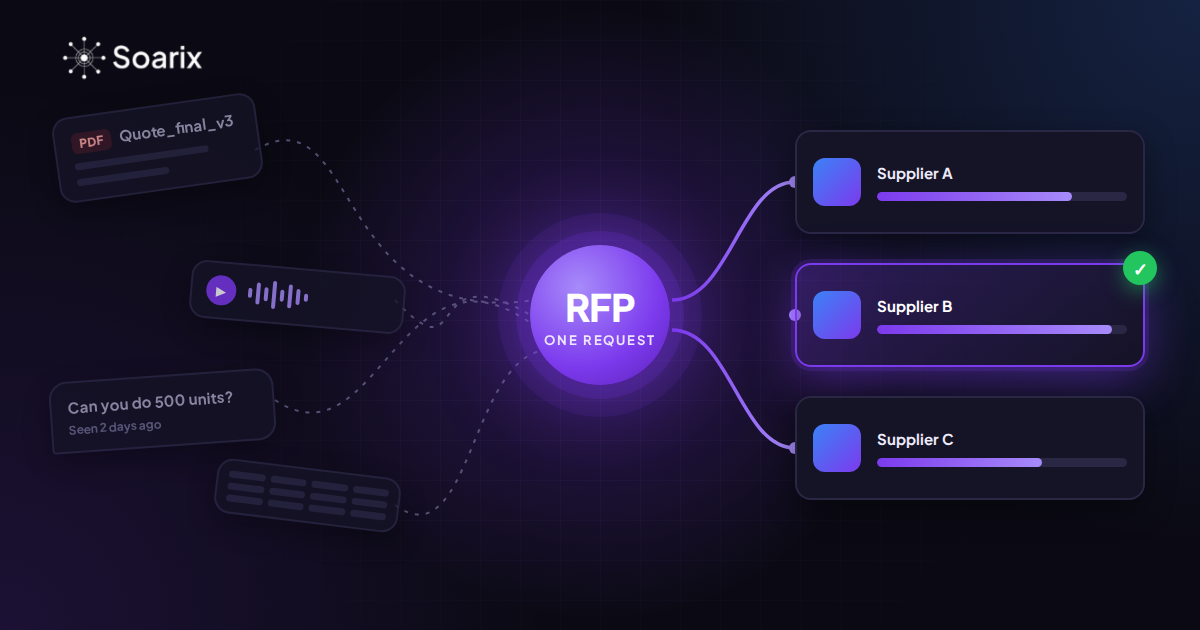
A structured RFQ isn't a longer form for the sake of it. It's the difference between three vendors interpreting your two-line message three different ways, and three vendors responding to the exact same requirement. Every RFQ on Soarix captures the fields that actually determine a good proposal: the category and sub-category of what you need, technical specifications, quantity and unit, delivery location and timeline, applicable compliance or quality requirements, and — where you choose to share it — a budget band. You fill it in once. Every supplier who receives it sees precisely the same requirement, with nothing lost in translation. 

Most of the "guessing with confidence" we described in our last post doesn't come from bad judgment. It comes from comparing three answers to three slightly different questions, because that's what three inboxes and three phone calls actually produce. A structured RFQ removes that variable before a single proposal comes back.

image

How AI supplier matching works

Posting a structured RFQ doesn't just standardise your ask — it's also what makes matching possible in the first place. You can't accurately match a requirement to a supplier from a two-line WhatsApp message. You can from a structured one.


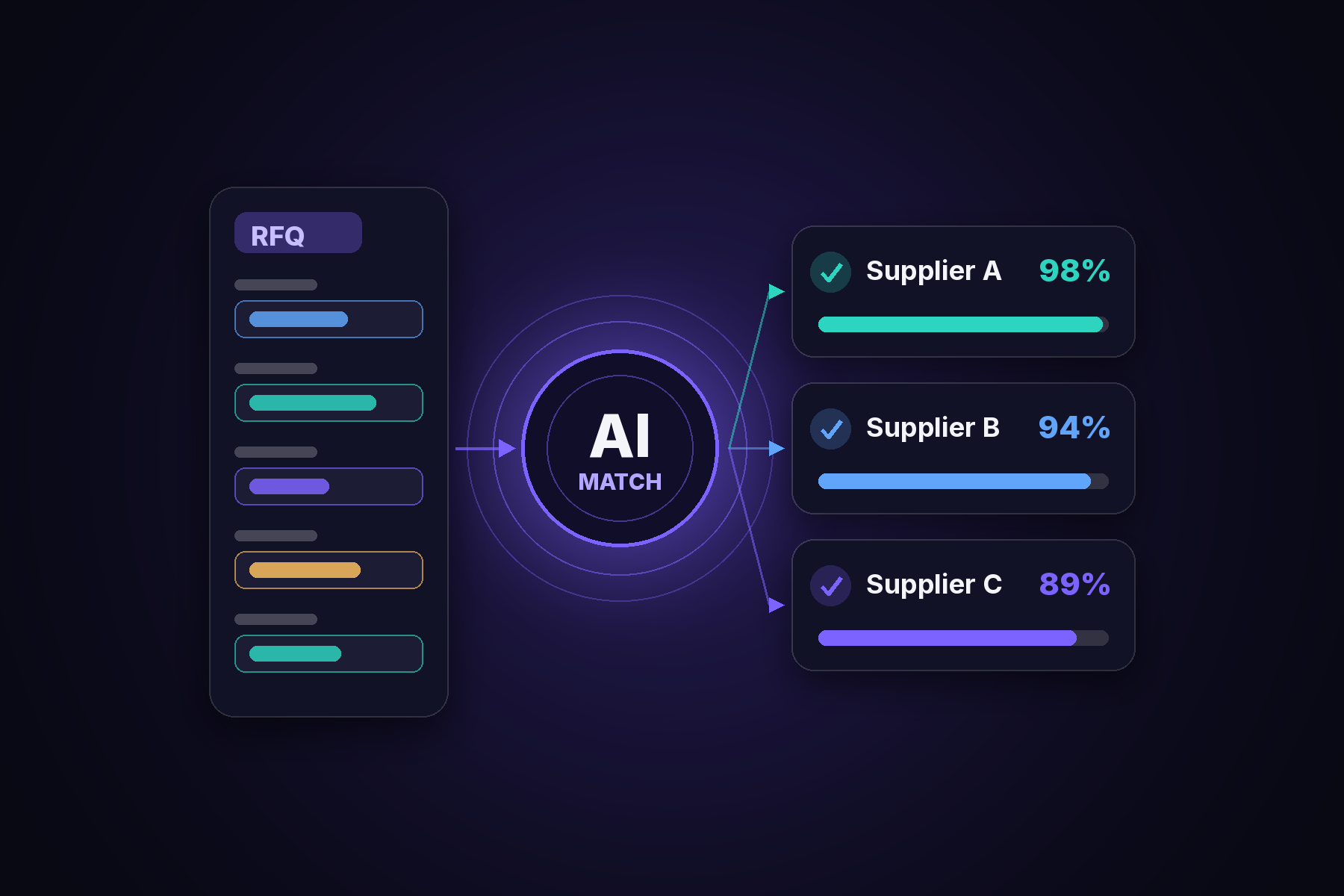
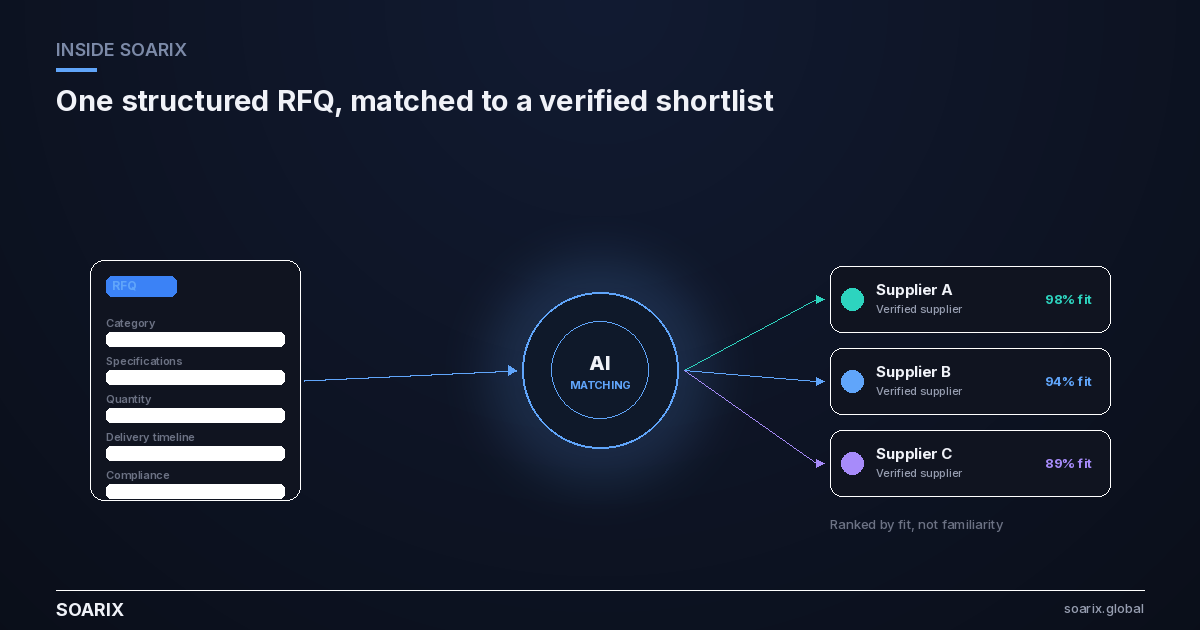
When an RFQ is posted, Soarix's matching engine compares it against supplier profiles across several dimensions: category and sub-category fit, production or service capacity, geographic reach, relevant certifications, and — over time — a track record of how reliably that supplier has fulfilled similar requirements. The output isn't a directory listing you scroll through. It's a ranked shortlist of suppliers who can genuinely deliver against what you asked for, including ones you've never worked with and may never have found on your own.


Most AI supplier matching tools built for global sourcing are designed around discovery from large product directories — useful when you're browsing an unfamiliar market. Soarix's matching works the other way: it starts from a structured requirement and a pre-verified Indian supplier base, so the shortlist you get is both fast and already qualified — not a list you still have to cold-contact and vet yourself.


This is also where the "discovery gap" from our last post gets closed. A manufacturer in Pune making exactly what a buyer in Hyderabad needs doesn't need a trade fair or a personal introduction anymore. If the requirement and the capability match, the algorithm surfaces it — the connection doesn't depend on who happens to know whom.


Curious what your first matched shortlist would look like?

Post a structured RFQ and see which verified suppliers match — no commitment.

Get Early Access →

Structured RFQ vs. the WhatsApp RFQ

Laid side by side, the practical differences are stark:
WhatsApp / email RFQStructured RFQ on Soarix
FormatFree text, inconsistent between vendorsFixed fields, identical for every supplier
ComparisonManual spreadsheet, error-proneApples-to-apples by default
ReachYour existing 3–7 vendorsAI-matched, verified supplier network
RecordNone — reconstructed after the factAutomatic audit trail

What supplier verification actually checks

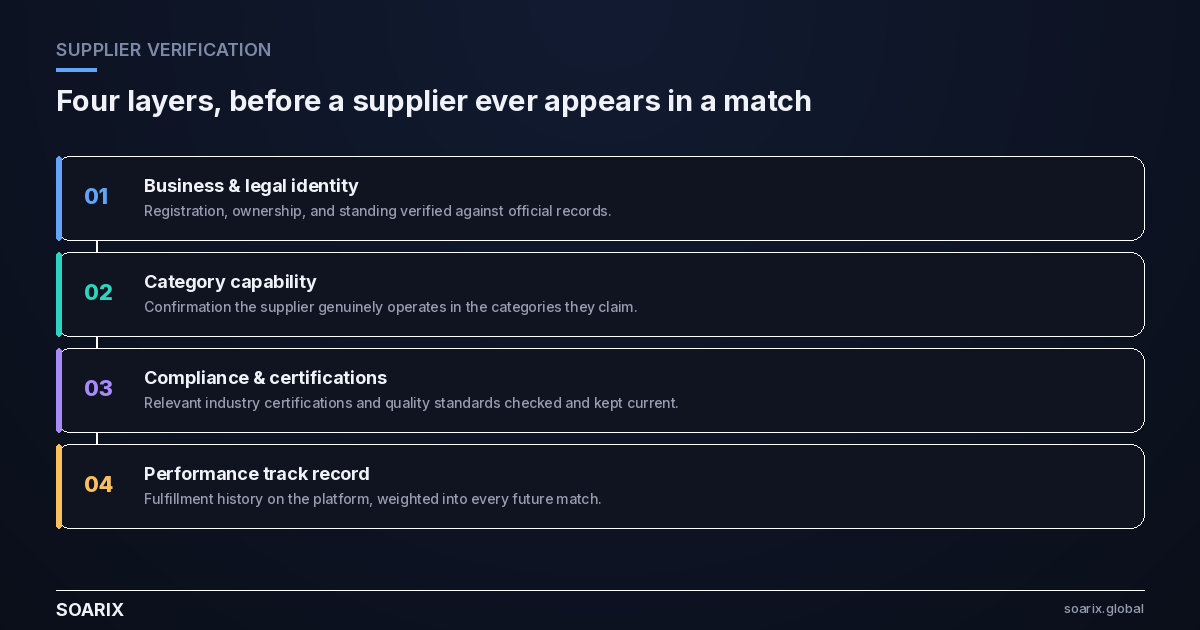
"Verified" is a word a lot of platforms use loosely — often little more than a badge next to a listing. On Soarix, it's a gate, not a badge. Before a supplier ever appears in a match, they go through checks across four layers.

  • Business & legal identity: Registration, ownership, and standing verified against official records.
  • Category capability: Confirmation the supplier genuinely operates in the categories they claim, not just a self-reported tag.
  • Compliance & certifications: Relevant industry certifications and quality standards checked and kept current.
  • Performance track record: Fulfillment history on the platform, weighted into every future match.

The effect compounds over time. Every completed RFQ adds to a supplier's track record, which sharpens the next match. A directory doesn't get smarter the longer it exists. A verified, structured network does.

image

"Verification isn't a checkbox at signup. It's a continuously updated layer that decides who's even eligible to appear in your next match." 


Combined with a structured RFQ, it's what turns a shortlist from "whoever responded" into "whoever can actually deliver."

Why this matters for your audit trail

We named this in our first post: when finance or compliance asks for the procurement record behind a purchase, most teams are reconstructing it from WhatsApp threads and email inboxes after the fact. A structured RFQ doesn't need reconstructing. Because the requirement, the responses, and the matched suppliers are already captured in one consistent format, the audit trail is a byproduct of the process — not a separate task somebody does later, under pressure, right before an audit. 

For regulated sectors — pharma, healthcare, manufacturing — that difference isn't cosmetic. It's the difference between producing a record on request and explaining why one doesn't exist.

See your requirement matched to a verified shortlist

Post a structured RFQ and get matched to suppliers ranked by fit, capability, and track record — not familiarity.

Comments

No comments yet. Be the first to share your thoughts!

Leave a comment

Your email will not be published.

Request a Callback

Get personalized guidance from our sourcing experts

We respect your privacy. No spam, ever.