
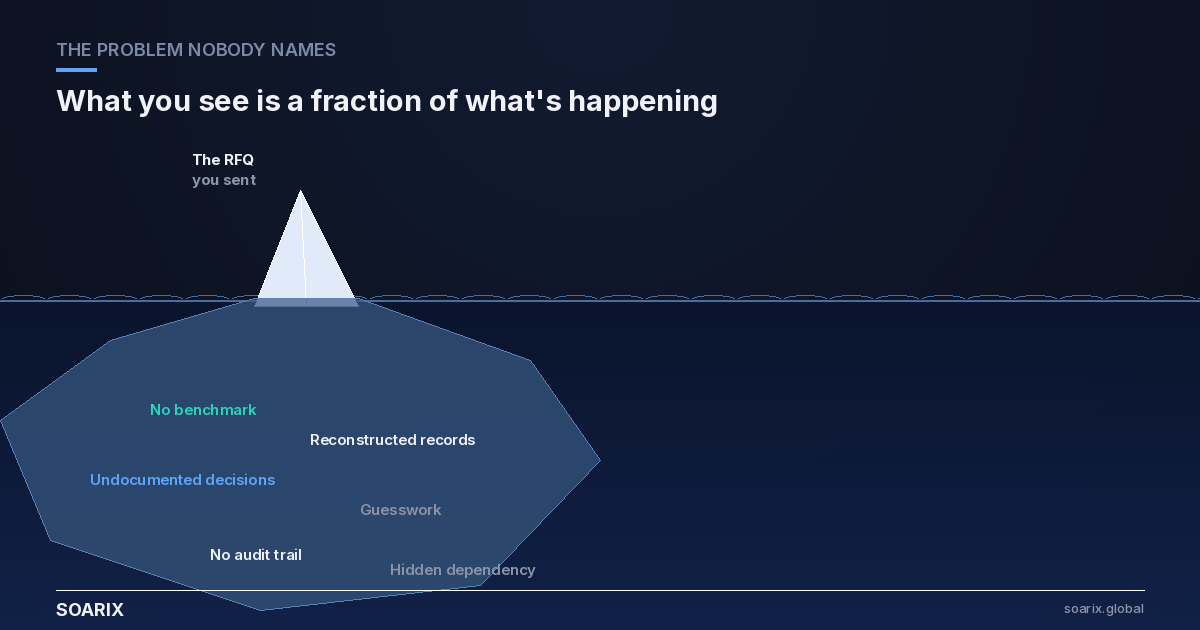
India's B2B procurement works - right up until it doesn't.
The problem isn't the people. It's the structure, or the absence of one. Here's
what that actually looks like across industries - and why it costs more than
most teams realize.
10 things happening in your procurement right now
The three-vendor ceiling
Most buyers work with 3–7 suppliers per category. Not because they're the best options - because they're the known ones. Familiarity becomes permanent, and permanent becomes a ceiling on everything your procurement function can achieve.
The WhatsApp RFQ
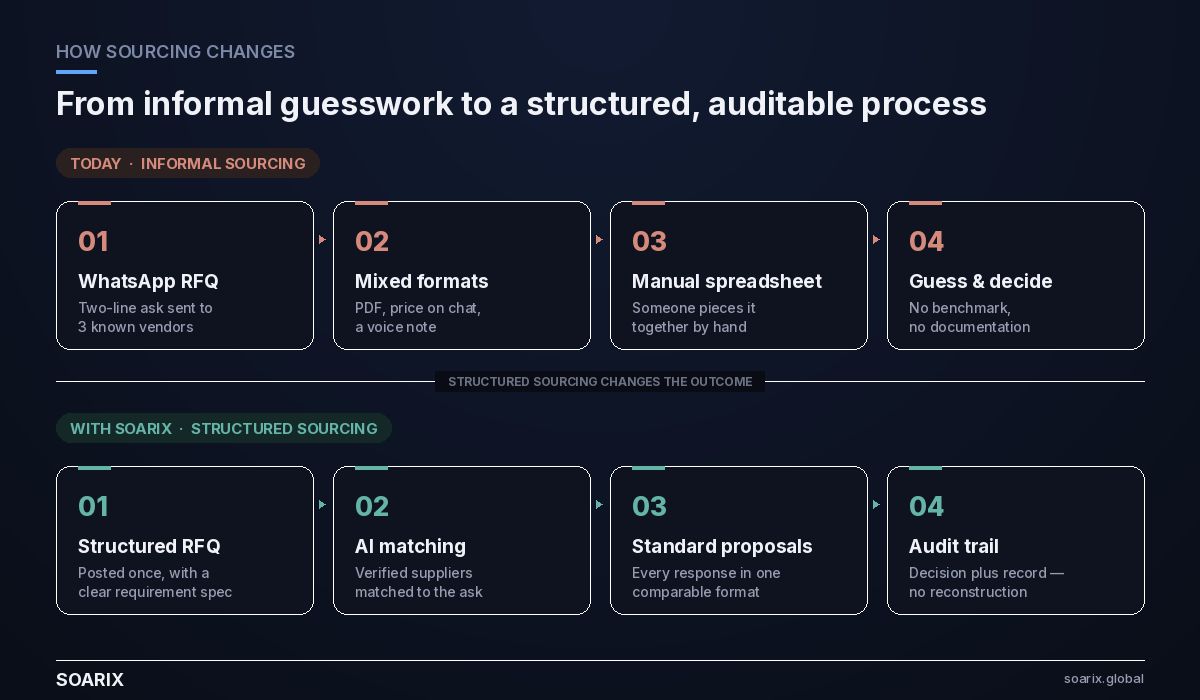
Most sourcing starts with an informal message. Requirement in two lines, three vendors, three different response formats. Someone builds a spreadsheet. A decision gets made. Nothing is ever documented. This is the standard operating procedure for most Indian businesses today.
Negotiating blind
When you work with the same vendors year after year, you lose your reference point. You don't know what the market will actually supply at. You negotiate from last year's rate, which was built on the year before. That's not benchmarking. That's guessing with confidence.
The audit trail that doesn't exist
When finance or compliance asks to see the procurement record for a significant purchase, the answer involves reconstructing from WhatsApp threads and email inboxes. People scramble. Documents get created after the fact. For regulated sectors - healthcare, pharma, manufacturing - this isn't just inconvenient. It's a liability.
Trade fairs are the only discovery method
Good suppliers exist that you've never heard of. The reason you haven't found them is that your process only looks where you already know to look. Trade fairs, cold calls, personal introductions - all of it is slow, expensive, and limited to whoever you happen to meet in that one room on that one day.
Good suppliers lose to inferior ones
A manufacturer in Pune or Gurugram making exactly what a buyer in Hyderabad or Delhi needs will never get that order if neither party has the right introduction. The gap between a buyer and the right supplier is rarely a capability gap. It's a discovery gap - and it runs in both directions.
Proposals you can't compare
Three suppliers, three different formats. A PDF, a price on WhatsApp, a voice note. You manually piece them together into a spreadsheet. The decision you make from incomparable inputs is, at its core, a guess - however experienced the person making it.
Hidden dependency on familiar vendors
When your supply chain runs through a handful of trusted suppliers, any disruption - a price increase, a capacity issue, a quality failure - lands with disproportionate force. The informal model creates fragility that only becomes visible at the worst possible time.
Procurement can't demonstrate its value
No data. No benchmarks. No record of decisions made and why. The procurement function has no case to make for itself. It becomes a cost centre by default - not because it isn't adding value, but because it has no evidence that it is.
The compounding cost
Every year of informal sourcing is a year of slightly wrong prices, slightly wrong suppliers, slightly weaker supply chain resilience. It doesn't hurt on any given day. It accumulates quietly into a significant gap - in cost, in quality, in capability - over time.
You're not alone - this is the default state of B2B sourcing in India, not the exception.
Recognize more than three of these in your own process?
Fix Now - Explore Soarix, Its Free! →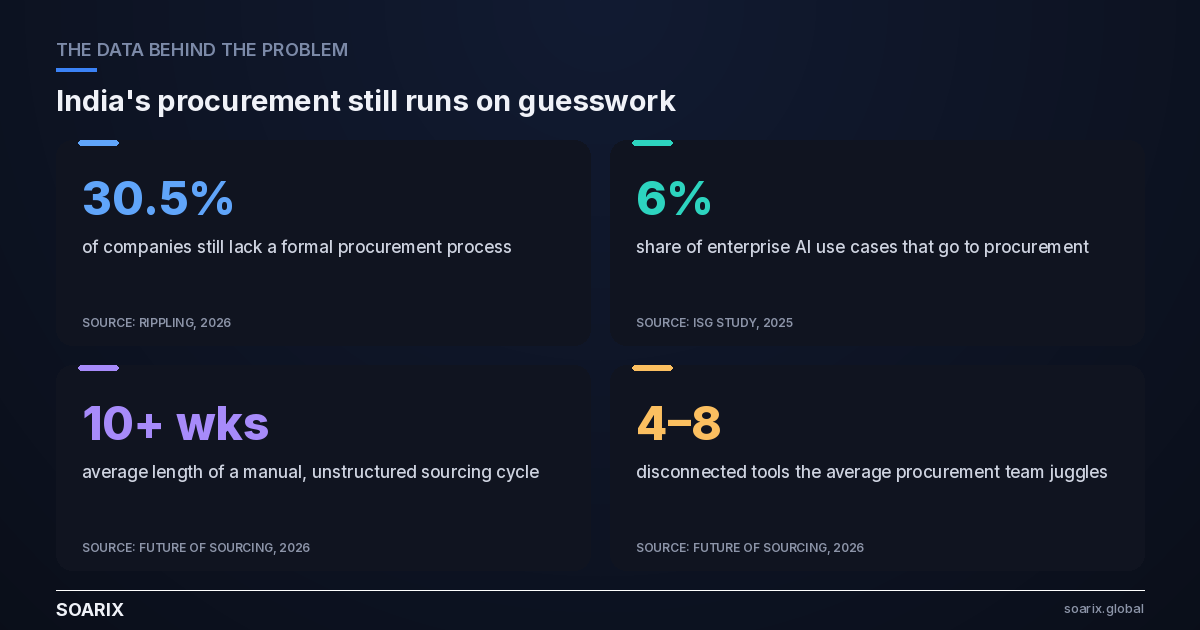
"The shift from informal to structured sourcing isn't a technology upgrade. It's a professional maturity shift - and it shows in the numbers fairly quickly."
Teams that document requirements, compare proposals side by side, and can trace every decision back to a reason don't just source better - they walk into every renewal, audit, and board conversation with evidence instead of anecdotes.
What Soarix does about it
Soarix is a buyer-supplier opportunity network. Buyers post
structured RFQs. AI matches them to verified suppliers who fit the requirement.
Proposals come back in a standardized format for side-by-side comparison. The
process creates its own audit trail - no reconstruction exercise when someone
asks questions later.
It's not a directory. It's not procurement software that
takes months to implement. It's the infrastructure that makes structured
sourcing the easy option rather than the hard one.
Stop reconstructing your sourcing decisions after the fact
Post a structured RFQ, get matched to verified suppliers, and compare proposals side by side - with an audit trail built in from day one. Learn how Soarix works